Sunday, 14 August 2011

Back for More

The daily puzzle
Shortly after waking up the other day, a trace of grumpiness still lingering, I decided I'd had enough. 'No more of this tomfoolery,' I said sternly. 'Basta. A world cyclist has his pride.' I stuffed my mouth with the remainder of a Nutella sandwich, gave the map of northern Greece a long hard look and took a swig of γάλα πλήρες (full-fat milk). 'Today,' I announced to no one in particular, 'I will take the motorway.'

Looking back on this momentous decision, I realise I had been working up to it for weeks, if not months. Now, don't get me wrong. There is nothing I would rather do than steer clear of interchanges, exhaust fumes and roaring trucks, and forever pedal down rolling country roads, brooks ababble and birds atwitter. As I never tire of telling myself, this trip is not about getting from A to B as quickly as possible. The world record for the fastest lap around the world is safely in the hands of a sun-burnt lunatic from England whose picture I saw in the shop where I bought my bike, and I have no intention of breaking it. But sometimes a world cyclist tires of pushing his heavy-laden mule up fifteen-percent inclines. Sometimes all he wants to do is crack on. Well, let me tell you, motorways just seem to be made for cracking on.

I savoured my first forbidden kilometres near Thebesa force to be reckoned with in ancient Greece but today just another sleepy provincial town. Before entering the motorway I paused to check for signs warning that what I was about to do is subject to corporal punishment. I didn't see any, so I took the plunge.

At first, things went swimmingly. The motorway that had looked so imposing on the map turned out to be a laid-back two-lane affair with a wide hard shoulder put there for my convenience. I was zipping along effortlessly. Could it be that this road is surfaced with some kind of special low-resistance asphalt, I found myself wondering. Or was it sheer excitement that was pushing me ahead? Moreover, no one really seemed to mind that I was there. The girl at the toll booth let me through with a smile, and the owner of a roadside restaurant refused to take my money when I wanted to buy a Coke.

Mikołaj and Piotr, my partners in crime
Just as I was thinking what I fine example I was setting to all those CO2-emitting Greeks cruising by, I heard the sound of a siren. My initial reaction was to ignore it. For a minute that seemed to work. Perhaps some moron with a customised claxon, I thought. Then it sounded again, this time a bit more insistently. Deciding that turning my head wouldn't make the situation any safer, I kept going. But I could feel something menacing creeping up to me. Then a large four-wheel drive overtook me. No police, I noticed to my relief. Some kind of road authority, by the look of it. I was escorted to the nearest exit and expected a good talking-to. And I think that's what I got, though I can't be sure. It was all Greek to me what this guardian of the motorway was saying. Fortunately, he was very patient with my faked astonishment. ('Really? So you mean I can't use this thing over here, a bicycle, on that road over there, a motorway? It's always so interesting to learn about national customs!')

Things were smoothed out when I was joined by two Polish brothers, Mikołaj and Piotr, who were caught for a similar offense: hitchhiking. The brothers, one of whom spoke some Greek, were forced onto a bus to Lamia, while I had to promise to stay away from the motorway. I tried to put on a solemn face, but deep down I knew I was like a dog that's had a taste of human blood. Sooner or later, that dog will be back for more.

Wednesday, 10 August 2011

A Day at the Office

At times I can't help but feel that this whole cycling thing I'm doing, slaving away in the saddle, is not unlike having a proper job. Granted, there are some notable differences, the most important of which is that, sadly, I don't receive a paycheck at the end of the month. Or a gift basket at the end of the year.

Every morning I get up at seven, the same hour my alarm clock used to go off when I was still at the old jobthe irony of it never fails to escape me. I toy with a bit of breakfast, get my things together and by nine I'm eating up the first kilometers, reluctantly at first, like a grumbling office clerk working his way through a stack of emails, but quickly brightening up as my legs find the right pace.

The good thing about this job is that there are no phone calls to answer, no obnoxious clients to deal with. There are deadlines to meet, however. In this corner of Europe campsites are thin on the ground, so it's essential to keep going, to make sure you reach that red triangle on the map before nightfall. Often, your efforts remain unrewarded. Many campsites seem to have vanished into thin air, probably closed down due to the crisis. The best thing to do then is to vent your frustrations at the watercooler, or, in my case, at the soft-drink fridge at the petrol station, where employees and customers alike tend to eye me somewhat suspiciously as I enter, as if I've just disembarked from a two-wheeled spacecraft. Invariably, they start shooting all kinds of questions. 'Where are you from? What's your destination? Why are your traveling alone? Have you come in peace? What does your wife make of this?'

The good thing about this quasi-professional attitude I've adopted is that it's easy to justify taking a few days off every now and then. These bikeless days really do feel like a kind of weekend. After two days of reading, pottering about and taking napsin other words, doing things that aren't too demanding for a sore behindI feel like a new man, ready to tackle the length of a medium-sized country.

Recently, I even went so far as to take a real summer break, combining a week in Athens with ten days of bliss on one of the Cyclades. Back at the office you realise holidays always turn you into a bit of a spoilt brat. 'What? I have to stay here all day? Exerting my brain and all that? No beaches, parasols, flip-flops?' It takes a few days to settle in again. If my stiff legs are anything to go by, I've still got some serious settling in to do.

Sunday, 31 July 2011

The Acropolis in 6 Shots

Cold is the heart, fair Greece! that looks on thee,
Nor feels as lovers o'er the dust they loved;
Dull is the eye that will not weep to see
Thy walls defaced, thy mouldering shrines removed
By British hands, which it had best behoved
To guard those relics ne'er to be restored.
Curst be the hour when from their isle they roved,
And once again thy hapless bosom gored,
And snatch'd thy shrinking gods to northern climes abhorr'd!
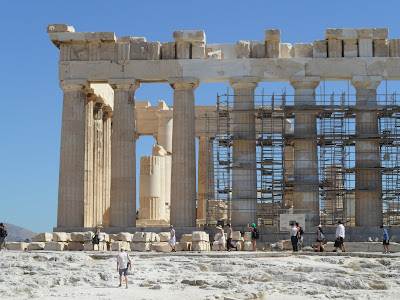
In Childe Harold's Pilgrimage, Lord Byron, never a man to mince his words, dedicates a couple of fuming stanzas to one of the greatest cultural controversies ever: the removal of half of the surviving sculptural decoration of the Parthenon and its subsequent shipping to England. Responsible for this act of cultural vandalism (according to the Greeks) or cultural preservation (according to the English) was another lord, Lord Elgin, who happily chiseled off the finest pieces, broke them up for easy transport and eventually sold them off to a reluctant British government. With half of the decoration in the British Museum in London and the other half in the Acropolis Museum in Athens, the Parthenon has lost much of its splendour. Today, the semipermanent scaffolding, like braces on an octogenarian, turns the entire thing into a rather sorry affair. A quick look at what remains of the Parthenon and the adjacent temples on the Acropolis.

The Propylaea: the entrance to the Acropolis

The Parthenon: the temple of Athena

Detail of the Parthenon Frieze

Parthenon floor plan

The Erechtheum

Marble base

Saturday, 16 July 2011

Circumstances

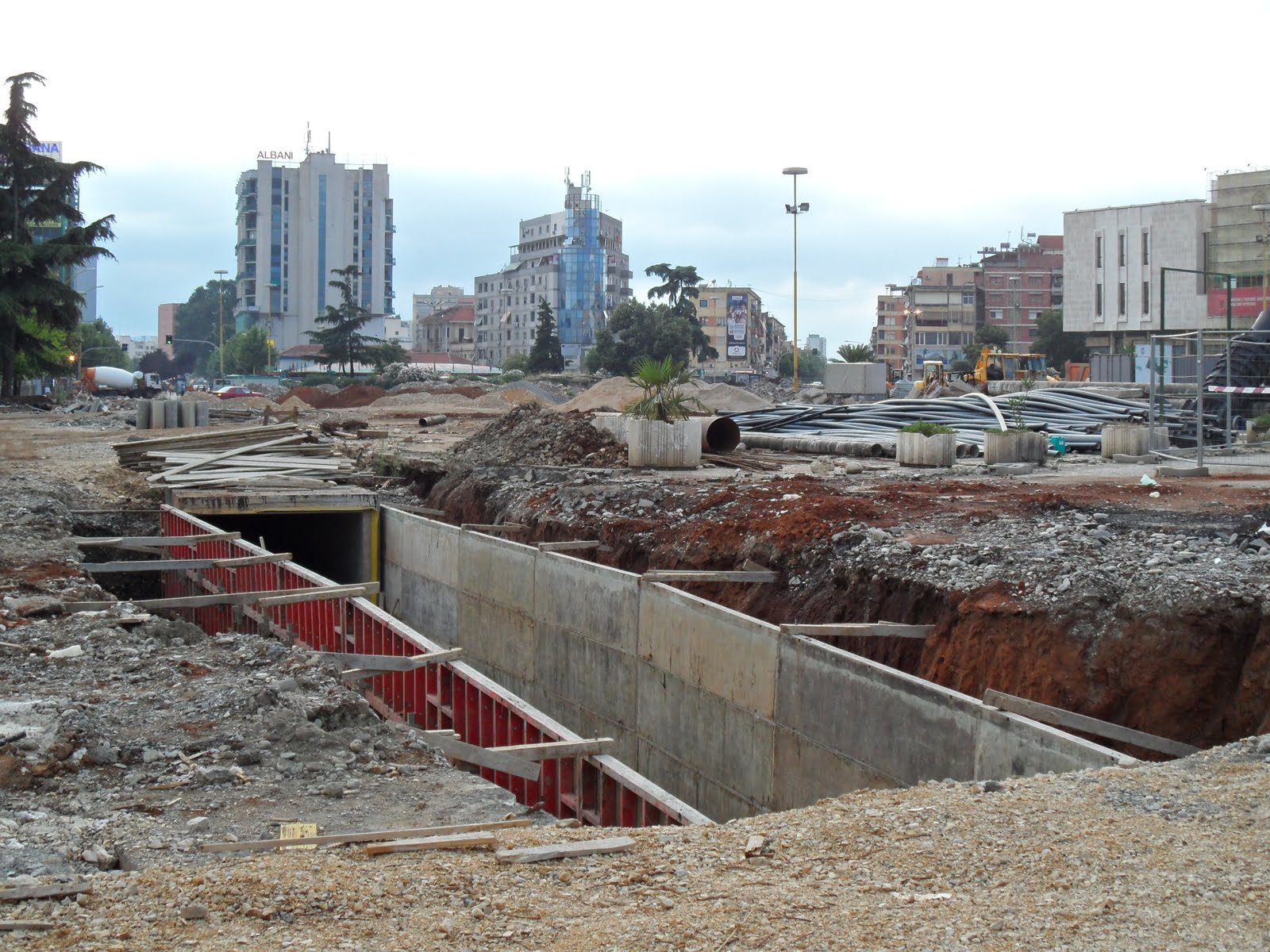
Downtown Tirana: work in progress
Albania. Hardly the first country that comes to mind if you're on the lookout for an attractive holiday destination. And that's a shame, because no one should miss out on its spectacular scenery, especially Lake Ohrid in the east, home to the endangered Ohrid trout, and the isolated Bjeshkët e Namuna (Accursed Mountains) in the north, where people still indulge in the occasional vendetta and clan members sometimes lock themselves in for years on end to keep from getting their throat slit. Having said that, I did miss out on these places. As always, circumstances got in the way.

In this case, the circumstances materialised in the form of infrastructure. Or, rather, the lack of it. Oh yes, maps of Albania will show you an abundance of roads in all the familiar colours: red-and-yellow for motorways, red for main roads, yellow for secondary roads and white for local roads. But that doesn't tell you a thing about the state they're in. What looks like a convenient thoroughfare on a map might be a pothole-ridden, spoke-cracking dirt track in reality.

An empty bottle and some playing cards turn any bicycle into a motorcycle
It's not that the Albanian roads have fallen into disrepair. Well, some of them obviously have, but the worst stretches I encountered on my north-south itinerary had been artfully pummeled into something that only vaguely resembled a road. It's the Albanian way of road maintenance: first smash the existing road into smithereens, let's say the 35-kilometer stretch between the Montenegrin-Albanian border and the northern town of Shkodër, then switch off the heavy machinery, sit back, wait for a couple of extra funds to come through, and then slowly and painstakingly start resurfacing a kilometer here, five hundred meters there, all the time making sure there is enough dust flying around to turn each passerby into a grey semblance of himself.

The Hoxha doctrine: make up for in bunkers what you lack in friends
Now, it's hard to do this when you're slaloming potholes the size of kitchen sinks, but one mustn't forget that Albania has come a long way. Forty years of communist rule under Enver Hoxha left the country in a pretty bad shape, both economically and politically. At the time of his death in 1985, there wasn't enough food to go around and there was no one the country could turn to, having left the Warsaw Pact in 1968 after a nasty fallout with the Russians. Those years of isolation are splendidly symbolised by the thousands of miniature bunkers that still dot the countryside. Almost impossible to remove, these concrete igloos serve as a permanent reminder of the grim Hoxha era. Of course, things didn't improve overnight with the advent of democracy. In the nineties Albania became a major hub for people trafficking, and, judging by the sheer number of spanking new luxury cars with foreign license plates, the market for stolen cars continues to thrive. In fact, most of Albania's economy appears to be of the 'unofficial' kind. Anywhere you go, you see men hanging around in the streets, waiting for a chance to get their hands on some quick cash. One of the most popular activities is lavazh, also spelled lavazho, which comes down to a concrete platform at the roadside and a bloke with a hose waiting to clean your car. I never really got the point of this, because the moment you pull out your car is covered in the same old cloak of grey dust.

Berat: Ottoman houses and Mercedes vans
Still, crossing Albania was a thoroughly enjoyable experience. Perhaps it's the people, who seem genuinely happy to see you. They wave, shout hello, sound their horn (which tends to get on your nerves once the honk rate tops one in three cars) and jump at every chance to practice their English, German, French or Italian. Some of the towns are not too bad, either. The old town of Berat was a real treat: whitewashed Ottoman houses with large rectangular windows, an overgrown but lively citadel, a full meal for two euros and a bit, and only a handful of tourists around. And camping on the bank of the Vjosë river was simply unforgettable, taking a swim in its warm shallow water while the sun set behind the mountains. So yes, even if the circumstances aren't always favourable, Albania does make for an attractive holiday destination. But one piece of advice: don't skimp on the rental car. Just go for the big four-wheel drive.

Friday, 8 July 2011

Up

The town of Kotor disappearing into the depths
Nothing beats dragging yourself up a particularly nasty mountain every now and then. It's bad news for your daily averageyou might only cover a third of the usual distancebut it's the shortest road to a profound sense of accomplishment.

First you are down there, no more than a lazy bugger among other lazy buggers. You pore over the map and carefully consider the serpentine road snaking its way up to a mountain pass. You know what you are in for. Then you are off. Initially, the road goes up gently. No mountain wants to scare off intrepid cyclists in the first few metres. Everything is going smoothly. You feel how your muscles tighten and relax, tighten and relax. Your breathing is deep and stable. Your legs are like the pistons of an engine. Body and bike are one.

But just when you start feeling smug, thinking that this mountain would never rate as a four-star col in the Tour de France, let alone hors catégorie, the mountain cranks it up a notch. You try to take that first punch like a man, losing speed but gaining determination. However, you know things are getting serious when your eyebrows get saturated and the sweat runs straight into your eyes. When you want to shift to a lighter gear and realise there is no lighter gear. When even a three-legged dog would have no difficulty keeping up with you.

Nice place for a mausoleum
Somehow you always make it to the top. There might be a neat little sign giving you the altitude and the name of the beast you have just slain. You prop your bike up against the sign and take a snapshot for the grandchildren. Often, there is nothing at all to mark your achievement. You realise you have made it when the road stops going up and starts going down.

My most recent conquest is Mount Lovćen, the monte negro that gives Montenegro its name. At least, I thought I was working my way up to the top of Mount Lovćen, but the road mysteriously ended just below the summit of Jezerski Vrh (1657 m), the second-highest peak of Lovćen National Park. Still, I got plenty of exercise, which was exactly what I needed after two days of idleness in the obscenely picturesque walled town of Dubrovnik.

Petrović Njegoš dozing off
Moreover, there was a nice reward waiting for me at the top of Jezerski Vrh. Not just a silly sign but an entire mausoleum, dedicated to a nineteenth-century Montenegrin hero I had never heard of before. This Petar II Petrović Njegoš must have been an important chap in his days, for someone had taken the trouble to carve a 28-ton likeness from a single block of black granite, not to mention the 461 steps leading up to this monstrosity. Cradled in the wings of an eagle, about to doze off, this Petrović Njegoš struck me as someone who had just cycled all the way up to the top of a particularly nasty mountain. Looked a bit done in, in my opinion, as if in dire need of a banana. In fact, there was something indescribably yawny about the place. I went out and attempted to admire the stupendous panoramic views of the national park, but I was actually chilled to the bone. It wasn't exactly cold out there, but with the soaking wet cycling gear still clinging to my body, it felt positively arctic.

After a five-minute descent, the first downhill metres of the day, I arrived at the mountain hut I had spotted on the way up. 'Free sleeping for hikers and bikers,' a sign said. Too good to be true, but there it was. I stripped the wet gear from my body and did a perfunctory job of washing myself with some cold water I took from a big bottle. At nine, I crawled into my sleeping bag and tried to keep myself warm with my breath. Slowly, the wooden hut turned into a marble mausoleum, the sleeping bag into the wings of an eagle, and I dreamt of reaching dizzying heights, never to come down again.