Saturday, 16 July 2011

Circumstances

Downtown Tirana: work in progress
Albania. Hardly the first country that comes to mind if you're on the lookout for an attractive holiday destination. And that's a shame, because no one should miss out on its spectacular scenery, especially Lake Ohrid in the east, home to the endangered Ohrid trout, and the isolated Bjeshkët e Namuna (Accursed Mountains) in the north, where people still indulge in the occasional vendetta and clan members sometimes lock themselves in for years on end to keep from getting their throat slit. Having said that, I did miss out on these places. As always, circumstances got in the way.

In this case, the circumstances materialised in the form of infrastructure. Or, rather, the lack of it. Oh yes, maps of Albania will show you an abundance of roads in all the familiar colours: red-and-yellow for motorways, red for main roads, yellow for secondary roads and white for local roads. But that doesn't tell you a thing about the state they're in. What looks like a convenient thoroughfare on a map might be a pothole-ridden, spoke-cracking dirt track in reality.

An empty bottle and some playing cards turn any bicycle into a motorcycle
It's not that the Albanian roads have fallen into disrepair. Well, some of them obviously have, but the worst stretches I encountered on my north-south itinerary had been artfully pummeled into something that only vaguely resembled a road. It's the Albanian way of road maintenance: first smash the existing road into smithereens, let's say the 35-kilometer stretch between the Montenegrin-Albanian border and the northern town of Shkodër, then switch off the heavy machinery, sit back, wait for a couple of extra funds to come through, and then slowly and painstakingly start resurfacing a kilometer here, five hundred meters there, all the time making sure there is enough dust flying around to turn each passerby into a grey semblance of himself.

The Hoxha doctrine: make up for in bunkers what you lack in friends
Now, it's hard to do this when you're slaloming potholes the size of kitchen sinks, but one mustn't forget that Albania has come a long way. Forty years of communist rule under Enver Hoxha left the country in a pretty bad shape, both economically and politically. At the time of his death in 1985, there wasn't enough food to go around and there was no one the country could turn to, having left the Warsaw Pact in 1968 after a nasty fallout with the Russians. Those years of isolation are splendidly symbolised by the thousands of miniature bunkers that still dot the countryside. Almost impossible to remove, these concrete igloos serve as a permanent reminder of the grim Hoxha era. Of course, things didn't improve overnight with the advent of democracy. In the nineties Albania became a major hub for people trafficking, and, judging by the sheer number of spanking new luxury cars with foreign license plates, the market for stolen cars continues to thrive. In fact, most of Albania's economy appears to be of the 'unofficial' kind. Anywhere you go, you see men hanging around in the streets, waiting for a chance to get their hands on some quick cash. One of the most popular activities is lavazh, also spelled lavazho, which comes down to a concrete platform at the roadside and a bloke with a hose waiting to clean your car. I never really got the point of this, because the moment you pull out your car is covered in the same old cloak of grey dust.

Berat: Ottoman houses and Mercedes vans
Still, crossing Albania was a thoroughly enjoyable experience. Perhaps it's the people, who seem genuinely happy to see you. They wave, shout hello, sound their horn (which tends to get on your nerves once the honk rate tops one in three cars) and jump at every chance to practice their English, German, French or Italian. Some of the towns are not too bad, either. The old town of Berat was a real treat: whitewashed Ottoman houses with large rectangular windows, an overgrown but lively citadel, a full meal for two euros and a bit, and only a handful of tourists around. And camping on the bank of the Vjosë river was simply unforgettable, taking a swim in its warm shallow water while the sun set behind the mountains. So yes, even if the circumstances aren't always favourable, Albania does make for an attractive holiday destination. But one piece of advice: don't skimp on the rental car. Just go for the big four-wheel drive.

Friday, 8 July 2011

Up

The town of Kotor disappearing into the depths
Nothing beats dragging yourself up a particularly nasty mountain every now and then. It's bad news for your daily averageyou might only cover a third of the usual distancebut it's the shortest road to a profound sense of accomplishment.

First you are down there, no more than a lazy bugger among other lazy buggers. You pore over the map and carefully consider the serpentine road snaking its way up to a mountain pass. You know what you are in for. Then you are off. Initially, the road goes up gently. No mountain wants to scare off intrepid cyclists in the first few metres. Everything is going smoothly. You feel how your muscles tighten and relax, tighten and relax. Your breathing is deep and stable. Your legs are like the pistons of an engine. Body and bike are one.

But just when you start feeling smug, thinking that this mountain would never rate as a four-star col in the Tour de France, let alone hors catégorie, the mountain cranks it up a notch. You try to take that first punch like a man, losing speed but gaining determination. However, you know things are getting serious when your eyebrows get saturated and the sweat runs straight into your eyes. When you want to shift to a lighter gear and realise there is no lighter gear. When even a three-legged dog would have no difficulty keeping up with you.

Nice place for a mausoleum
Somehow you always make it to the top. There might be a neat little sign giving you the altitude and the name of the beast you have just slain. You prop your bike up against the sign and take a snapshot for the grandchildren. Often, there is nothing at all to mark your achievement. You realise you have made it when the road stops going up and starts going down.

My most recent conquest is Mount Lovćen, the monte negro that gives Montenegro its name. At least, I thought I was working my way up to the top of Mount Lovćen, but the road mysteriously ended just below the summit of Jezerski Vrh (1657 m), the second-highest peak of Lovćen National Park. Still, I got plenty of exercise, which was exactly what I needed after two days of idleness in the obscenely picturesque walled town of Dubrovnik.

Petrović Njegoš dozing off
Moreover, there was a nice reward waiting for me at the top of Jezerski Vrh. Not just a silly sign but an entire mausoleum, dedicated to a nineteenth-century Montenegrin hero I had never heard of before. This Petar II Petrović Njegoš must have been an important chap in his days, for someone had taken the trouble to carve a 28-ton likeness from a single block of black granite, not to mention the 461 steps leading up to this monstrosity. Cradled in the wings of an eagle, about to doze off, this Petrović Njegoš struck me as someone who had just cycled all the way up to the top of a particularly nasty mountain. Looked a bit done in, in my opinion, as if in dire need of a banana. In fact, there was something indescribably yawny about the place. I went out and attempted to admire the stupendous panoramic views of the national park, but I was actually chilled to the bone. It wasn't exactly cold out there, but with the soaking wet cycling gear still clinging to my body, it felt positively arctic.

After a five-minute descent, the first downhill metres of the day, I arrived at the mountain hut I had spotted on the way up. 'Free sleeping for hikers and bikers,' a sign said. Too good to be true, but there it was. I stripped the wet gear from my body and did a perfunctory job of washing myself with some cold water I took from a big bottle. At nine, I crawled into my sleeping bag and tried to keep myself warm with my breath. Slowly, the wooden hut turned into a marble mausoleum, the sleeping bag into the wings of an eagle, and I dreamt of reaching dizzying heights, never to come down again.

Thursday, 30 June 2011

Rooftop

Local pastime: diving off of the Stari Most (Old Bridge)
Maybe wearing flipflops wasn't such a good idea. I pause for a moment to mop the sweat from my brow and gather my wits. How to get to the next flight of stairs without losing a toe? I take a deep breath, then continue inching my way forward. In the late afternoon light, the shards of glass at my feet flicker menacingly.

I am climbing the Ljubljanska Banka Tower, a derelict nine-storey building just a short walk away from Mostar's famous Old Bridge. Derelict, however, is a hopelessly inadequate description of the state of this building. Bombed out, utterly gutted by artillery fire in the 1990s civil war, all that remains today is an eerie skeleton frozen in time, silently watching how the town below shakes off the dust and rises to its feet.

The two faces of Mostar
I came to Mostar to get a brief respite from the Jadranska Magistrala, the coastal thoroughfare that runs the length of the former Yugoslav Federation, from Slovenia in the north to a place well south of the scope of my map of Croatia. Jadranska Magistrala. The sound of it is enough to give you the shivers. The road, hewn out of the precipitous cliffs of the Adriatic coast, cuts through top-notch scenery: barren mountains to your left, the bluest of blue waters to your right and each climb rewarded with a view of a delightful cove, or an island glimmering afar. But to fully appreciate the glory of the Jadranska Magistrala you would do well to bring four wheels rather than two. Cyclists have no choice but to keep their eyes glued to the narrow road, taking care not to get tipped over the edge by a passing lorry or an Italian family in a camper car. (It's your bleedin' holiday, why the rush?!).

However, Mostar wasn't as peaceful as I had hoped. Taking snapshots of young lads diving off of the beautifully reconstructed bridge, the ice-cream-licking crowds pushed me away from the cobbled lanes of the Old Town into a quiet area yet untouched by the careful hand of the restorer, the hand that covers everything. As I walked along the former front line, I lost count of the number of burnt-out houses I saw, their facades perforated, young trees peeping out of paneless windows. Across the river I stumbled upon a small cemetery. Each gravestone revealed a different name, a different face. There was one constant. The vast majority of the dozens resting there had died in the summer of 1993.

Climbing the Ljubljanska Banka Tower
On the rooftop of the Ljubljanska Banka Tower I am alone at last. I feel elated having made it all the way up without injuring myself. And no one here to block the splendid 360-degree city view. But after a minute or so it gets to methe rubble, the hollow-eyed buildings I have seen that day, the fact that I am happily taking snapshots of things that are beyond my imagination. Suddenly, I feel horribly out of place. I clamber down quickly, eager to hit the tourist-filled streets again.

Thursday, 23 June 2011

sLOVEnia

The Soča: a rafter's paradise
Travelling without a clear plan, enticing as it may seem, can be something of a nerve-racking experience. Especially when you're the kind of person who is meticulous about the simplest of things: taking care not to crack the spine when reading a book, paying each exhibit in a museum the attention it deserves, making a to-do list for things that don't really need a to-do listYou get the idea.

What it comes down to is that I keep asking myself questions such as: how do I make sure that my objective itinerary through a particular country or region is, in fact, a route worth perspiring profusely for? Of course, I ask around, and there's always my not very detailed and thus not very helpful guidebook covering the entire Mediterranean. But at some point you have to make up your mind, turn left or right and just enjoy whatever the road serves you up.

Cycling in Slovenia, for that matter, is an almost therapeutic experience. This tiny speck on the map, wedged in between the Austrian Alps to the north, Italy to the west, and Hungary and Croatia to the east and south, is nothing short of sensational. Here, it doesn't matter whether you turn left or right, the country keeps shoving mind-blowing scenery in your face.
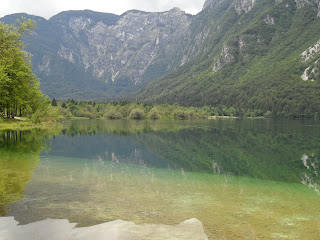
Lake Bohinj, less touristy than Lake Bled
I entered Slovenia at Nova Gorica, which, together with its Italian counterpart Gorizia, makes up a decent-sized town. Still, having just winded my way through Gorizia's colourful streets, Nova Gorica strikes the unsuspecting first-time visitor as a bit of an afterthought. It is, as it turned out, hence the 'Nova' part in the name of the place. But that was something my host for the night had to point out.

Gorizia used to be the capital of the former Slovenian province of Goriška. When after WWII the Italians took control over the place, the new socialist regime in Yugoslavia thought it would make a nice statement to build a brand-new town right next to it on the eastern side of the border. According to my host, they drew up some pretty ambitious plans, only a small part of which was ever carried out. Today, grim apartment blocks loom large, interspersed with the odd casino. The entire local economy depends upon attracting short-stay visitors from Italy, where casinos are rather thin on the groundan opportunistic move that brought about the steady decline of a once-thriving cultural scene.
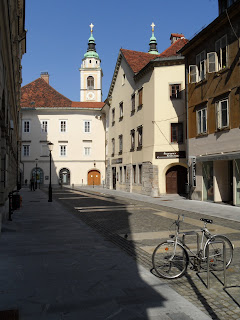
Madness in downtown Ljubljana
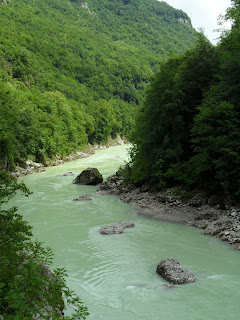
From Nova Gorica I headed north along the banks of the Soča river (Isonzo in Italian), a major WWI front and the backdrop to Ernest Hemingway's A Farewell to Arms. More of a gorge than a valley, I kept shaking my head in disbelief at the contrast with the drab Italian Po valley I had just left behind. At the village of Most na Soči I turned right, ready for a frolic in the Julian Alps. However, within minutes the fine drizzle I had been trying to ignore turned into a fully-fledged thunderstorm. Having enjoyed ridiculously good weather ever since my departure from Holland, I tried not to curse, got out my rain kit and pedalled on. Even through the rain-covered lenses of my cycling glasses I couldn't help being amazed by the beauty of it all. Dense forests, deserted country roads, a cluster of white houses huddled around a charming church. Soaked and knackered, I ended up staying in a mountain hut. Seven euros for the night, and for a bit more the owner was happy to chop some wood and light a fire so that I could enjoy a warm shower. Later that night, I had to make an effort not to fall asleep and land my face into a bowl of piping hot pasta.

I continued my tour of Slovenia with a visit to the mountain lakes of Bohinj and Bled, decided to take a break in Ljubljana, with its stamp-sized historical city centre, and rounded it all off with a quick peek into the Unesco-listed Škocjan caves. Nearing the Croatian border, I noticed that rather than looking forward to entering a new country I felt sorry to leave the one I had just visited. And so, awaiting my turn at the border checkpoint, it seemed only appropriate to softly repeat after the national tourist board: I feel sLOVEnia...
Tuesday, 14 June 2011

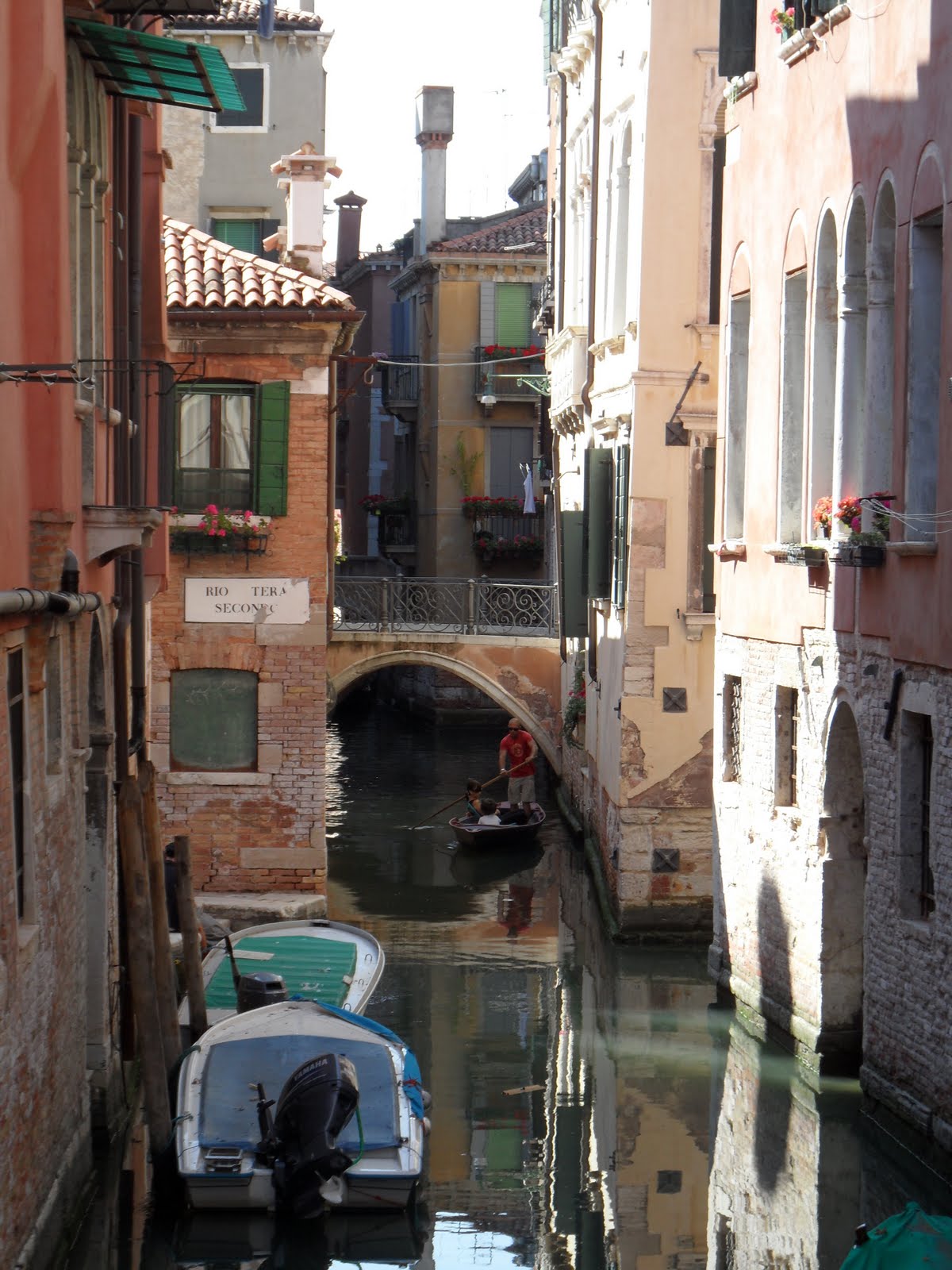
Venice in 6 Shots

117 islands, 177 canals, 409 bridges, 0 cars, 60,000 inhabitants, up to 25 million visitors a year and 1 big problem: the entire place is slowly sinking. An impression of Venice in 6 shots.