Thursday, 29 September 2011

Hamam

The wise men from the East
Sometimes all we need is to be away from this world. Away from our demanding jobs, evaporating savings and crushed hopes. Some like to drink themselves into a stupor on a Friday night, but most are content to hit the sack at the end of a long day and drift off into a dreamless sleep. Having ample experience in both fields, I was glad to discover the Turks have found a third path that leads to the river Lethe: the hamam.

I always thought the hamam serves the dual purpose of getting clean what is dirty and catching up on the latest with your cronies. Little did I realise that a visit to the hamam extends beyond the realm of the physical and social and touches on the spiritual.

As a first-timer I entered somewhat apprehensively, not knowing what to expect or how to behave. While my companions ordered the full programme for the three of us, I gazed up in admiration. We were standing in a wood-paneled reception room that reminded me of the Moorish courtyards in Seville: two storeys separated by an elevated gallery, small rooms opening out onto a central space adorned with a trickling fountain. We retired to one of these cubicle-like rooms to exchange our dusty clothes for checkered loinclothsnudity seems to be a definite no-no in hamams. Even in this tiny changing room everything was set for pure relaxation: low light, toned-down colours and comfy beds inviting us to take a little nap later on.

Clickety-clacking on our flip-flops we entered the main bath chamber. Through clouds of steam I could make out the shape of a masseur hovering over what looked like a walrus lying face-down on a marble slab. We retreated to an alcove for some fooling around with running taps and plastic scoop-dishes, and then hung around in the sauna until we nearly passed out. After a cold shower it was our turn for a good scrub. The effect the kese (abrasive mitt) had on me was rather embarrassing. As my masseur scrubbed away at my tanned limbs, grime and dead skin amassed into thick grey worms. He smiled delightedly and showed me the fruit of his labour.

After another shower we returned to the heated slab for a final massage. By blowing air into soapy cotton sacks our moustached masseurs managed to cover us in a deluge of foam and then set to work, kneading and twisting away. It was pure bliss. 'Everyone deserves this,' I thought as they wrapped us in soft towels. 'Make hamam visits mandatory, especially in times like these, and the world will be a different place.'

Wednesday, 21 September 2011

Stuck

Backgammon...
The best view of Ankara is the one you get on the way home, the saying goes. True, Ankara is no Istanbul. It's an artificial capital, a carefully planned city that's all but swallowed up the ancient citadel that lies at its heart. When Atatürk declared it capital of the Turkish Republic in 1923, he envisioned this provincial backwater as a modern, secular metropole on par with its Western counterparts. In terms of population growth he certainly succeeded: from a mere 30,000 souls in 1923 to 4,5 million today. However, these staggering figures can't hide the fact that something is missing. There are no atmospheric neighbourhoods, no sights to speak of. Moreover, the lack of landmarks makes it difficult to orient yourself. Even after two weeks, central Ankara strikes me as a jumble of faceless streets.

For travelers, the redeeming feature of this city is its abundance of embassies. I came here hoping to sort out my visas for Iran and Pakistan. Surprisingly, it turned out the former shouldn't be too much of a headache. In fact, there's no need to go to the embassy, wait for your turn and deal with ill-tempered officials who don't want you to visit their country in the first place. Just fill in a form, send it to one of the online visa agencies that have sprung up in recent years and select the Iranian consulate where you wish to pick up your visa.

...and nargile: the perfect combination
That's the good news. For Pakistan, again much to my surprise, things are looking bleak. To put it mildly. A fellow traveler told me that since a year or so it's virtually unheard of to be granted a visa when applying in a country other than your home country. A quick visit to the Pakistani embassy confirmed this. It seems my only chanceand a very slim one at thatis to send my passport home and let someone apply on my behalf. Oh, but first I would need to book a flight to Islamabad, make a reservation at a five-star hotel and procure an official letter of invitation from a Pakistani friend, tour agency or business contact that must be approved by the Ministry of Foreign Affairs. That's all, sir.

Meanwhile, Ankara has played its little trick on me. Having decided that the Pakistani visa will have to wait, there is no reason for me to prolong my stay. But somehow I find it impossible to leave. 'That's the way it goes,' one of my hosts told me, himself a Singaporean national. 'No one in his right mind would want to spend more than a day here. Those who do end up in Ankara invariably get stuck.' So we while away the days playing backgammon, drinking buckets of çay and going on small errands that somehow take up lots of time. It's not so bad, actually. Guess that view of Ankara will have to wait a bit.

Friday, 16 September 2011

Oasis

Fruit sellers on a parking lot
'Bread? You want some bread?' 'Well, sure,' I stammer. But before I get the chance to repeat I really only need directions to the nearest bakery, the stout man I'm talking to has disappeared. I've stopped at a small parking lot next to the main road. It's a parking lot like any other, save for one special feature: a tap connected to a nearby mountain spring. The cool water, which never stops running, attracts scores of people. Thirsty travelers like me, of course, but also elderly couples from neighbouring villages who come here to fill up all the empty bottles their cars can hold. A concentration of people always means business, and it's no different here. Fruit sellers have set up stalls overflowing with local produce. A sullen teenager is roasting mısır (cornstalks) on a bed of embers. An improvised restaurant serves pide and köfte.

'Here, take as many slices as you like.' Fresh wholemeal bread. Just what I was looking for. 'Eh, thank you,' I stammer again, still not wholly accustomed to these small acts of kindness, which seem to come natural to people in Turkey. 'Are you sure you don't need this yourself?' 'Don't worry,' he says, 'we can always get some more on the way home.'

He tells me he's just spent a week in his summerhouse on the Sea of Marmara, together with his mum and a friend. We all shake hands. 'You know what? Why don't you drop by when you cross our town? Just give us a ring and we'll come and pick you up.' He hands me his phone number. 'We'd love to have lunch with you.' I nod and smile, not sure what to say. I think of Holland, where no one drops by unannounced. Where it's virtually impossible to meet up with someone if you haven't made arrangements at least four weeks in advance. Where visitors are supposed to bugger off as dinnertime approaches.

Before we say goodbye, my benefactor walks to his car and returns with a bulging bag. 'Here, take this. See you soon.' The three of them get into the car and drive off. I peek into the bag. Prunes, peaches, grapes, a tomato. Then, out of the corner of my eye, I see someone gesturing. It's one of the fruit sellers, waving at me to come over. He's holding a knife in one hand, a small melon in the other.

Saturday, 10 September 2011

Istanbul in 6 Shots

Byzantium, Constantinople, Istanbul. The western terminus of the Silk Road. The historical gateway between East and West. A place so charged with symbolism I can't help but feel I'm facing yet another Kilómetro Cero. As if the 10,000 kilometres that led me here have been nothing but a prelude to the real stuff. 'This is where it begins,' the city whispers.

Ferry dock in Kadıköy (Asia)

Yeni Camii (New Mosque)

Some mosques just can't handle the crowds

The Sultanahmet skyline

Commuting made fun: a ferry ride across the Bosphorus

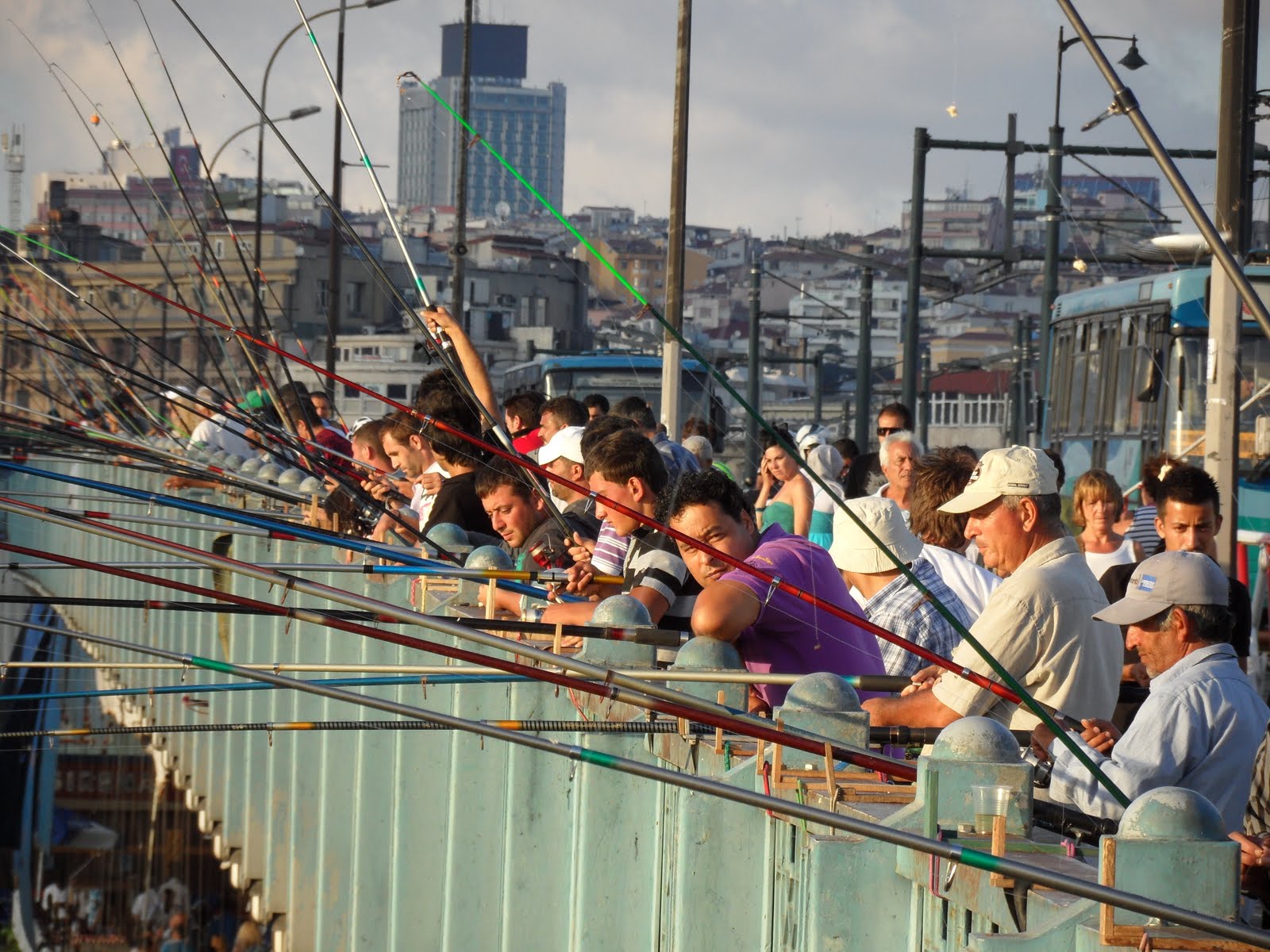
Competition is fierce on the Galata Bridge

Tuesday, 30 August 2011

Black Hole

Joining the frenzy
It's mad, it's bad, it's dangerous. It's also one of my best experiences so far: riding into Istanbul at rush hour. I've tackled several big cities since I set off, and if I've learnt one thing it's this: you never know what you gonna get. Barcelona was hectic with its string of junctions, but the good thing is that there aren't any confusing suburbs to contend with if you're coming from the south. Marseille was a joy, cruising through bustling immigrant neighbourhoods all the way down to the yacht jungle that is the Vieux Port. Tirana cost me a year of my life: I'm still coughing up the soot that thousands of miserable Mercedes Benzes sent flying around. And Athens, one that I hadn't been looking forward to, turned out to be a breeze: a single straight road that shuttled me right into the heart of the cityOmonia Square and Syntagma Square.

Gavin on his recumbent
But Istanbul... The place has something of a reputation among cycle tourists. I remember reading about a chap who was a bit too hesitant at the busiest junctions and ended up waiting for gaps in the traffic that never materialised. Determined not to let that happen to me I decided to take a breather and brace myself for the plunge. Suddenly, something big pulled up next to me, blocking the sun like an ocean liner. Another cyclist! But not a regular one. The bloke smiling at me from under a bright red cap was riding a recumbent. This in itself is quite unusual, but what made it positively stupefying was the fact that it was packed like a camel. I counted no less than six panniers, and the entire thing seemed to be held together by a web of straps, hooks and drying clothes. Gavin, however, is no flying (or riding) circus. This Englishman left southern France in May, cycled to the UK to say goodbye to his folks and then headed southeast, covering seven thousand kilometres in three months. Examining the monster he was sitting on I could hardly believe it. 'There's food for four days,' he told me, 'and I can carry a week's supply of water if necessary.' To my relief he admitted he isn't lugging around his entire household. 'In Slovenia I got rid of a machete and a wok.'

Together we formed a solid block that made the fifty-kilometre descent into madness a little less insane. We dodged swerving lorries, navigated extensive stretches without a hard shoulder and marveled at the immensity of it all. Gavin likened it to a black hole, and that's exactly what it is. Anything coming too close to this sprawling city will be sucked up without mercy. Maybe that's why road rules don't seem to apply here: motorists just have no volition of their own.

With people cheering us on from open car windows and the sun setting over the chaos, we made it to Bakırköy in one piece, just in time for the last ferry to the Asian side. First occurrence on the new continent: a cracked spoke. It didn't even bother me. It had been a glorious day, and the best part of it was that there had been someone to share it with.