Wednesday, 30 November 2011

Southeastern Turkey in 6 Shots

I'm a firm believer in the theory that all motorised modes of transport are the devil's invention. That's why I'm pretty radical about the way I want to do this trip. No cars, no trains, no buses, no planes. I could pat myself on the back for treading lightly, but the main thing is that traveling just seems more real when you set yourself in motion.

When it comes to side trips these hard and fast rules somehow don't apply. They're not part of the actual journey anyway—that's what makes them side trips. No pangs of guilt then, when I decided to take a bus south and make a little tour of the Euphrates and Tigris basin. In Diyarbakır, a city that wears its Kurdish identity on its sleeve, I joined the shopping frenzy one day before Kurban Bayramı, the Festival of the Sacrifice. In the bluff-top town of Mardin I watched the sun go down behind the endless Mesopotamian plain. In the backstreets of Midyat little punks pelted me with stones (no Major League material there). And in Hasankeyf I was told I was one of the last tourists to visit the village, as the entire place will be washed away as soon as the construction of a nearby dam is completed. Excellent little excursion, but after nine days I was dying to get back to my yoke and plough again.

Stocking up on sweets for Kurban Bayramı
Mardin: citrus-press domes, great views of Syria
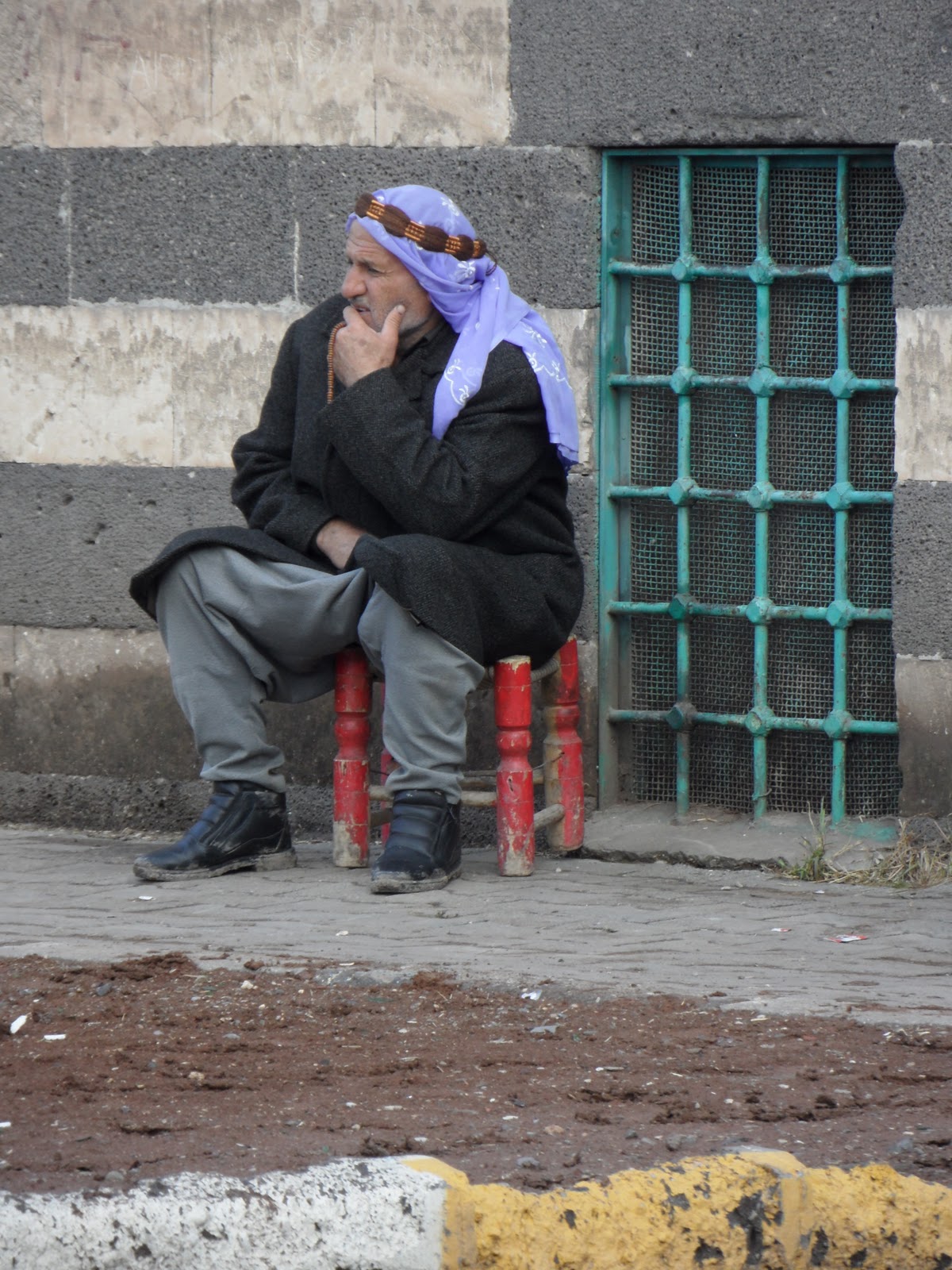
Kurdish man in traditional dress
Hasankeyf boy skipping stones on the Tigris
Mardin post office: ornate facades abound in this region
Baklava and kadayıf: don't eat more than a pound or you'll live to regret it

Friday, 11 November 2011

Backdoors and Detours

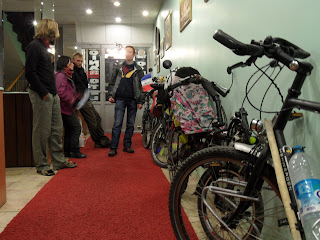
Who needs a conference room when you have a hotel lobby?
Life used to be pretty straightforward for overlanders traveling from Turkey to eastern Asia: head to the dreary border town of Doğubeyazıt, situated at the foot of Mount Ararat, draw a more or less diagonal line between Iran's northwest and southeast, cross into Pakistan, and then go wherever your fancy takes you, be it the northern road to China or the eastern one to India. A classic route that is all but history due to Pakistan's recent crackdown on—no, not the local chapter of Al-Qaeda loonies—but happy-go-lucky travelers eager to explore the marvels of the country. Visa applications can now only be filed in the country of origin. And rightly so, of course. Those blasted hippies collecting visas as they go simply can't be trusted.

With the arrival of no less than four cyclists, the atmosphere at the hotel in Erzurum took on a distinct quality of nervous apprehension. All of them—the French couple on their recumbents, the French boy they had picked up along the way, the ginger software developer from Südtirol—had given up any hope they had of traversing Pakistan. Too much of a hassle. That put them in a tight spot, and they knew it. Once you've entered Iran your exit options are limited. Central Asia, though beautiful, is far too cold in winter and makes Pakistan look like Luxembourg when it comes to granting tourist visas. The only alternative, Afghanistan, is out of the question for obvious reasons.

Best time to visit the Georgian valleys: autumn
There is a backdoor, however, a plan so cunning you could stick a tail on it and call it a weasel. (Now, who said that again...) The only drawback is that this workaround is still in beta. The idea is to catch a ferry from Iran to Dubai and then hitch a ride on a cargo ship bound for India. Gavin, the English cyclist I wrote about in the Black Hole entry, bravely decided to give it a shot. As far as I know he got stuck in Dubai and is now desperately roaming the docks looking for a captain willing to take him aboard.

For me, the Dubai route is merely a backup, something to consider if all else fails. I've got my mind set on cycling the Karakoram Highway, a 1300-kilometre high-altitude roller-coaster ride linking Pakistan and China. Apart from the visa drivel there is just one complicating factor. The road is officially closed from the first of January till the first of May. If snowfall persists, that date could be pushed back. Unwilling to bet on too many visa extensions—thirty days are standard for both Iran and Pakistan—I've got some serious time to kill before entering Iran. That's why I'm crossing Turkey like a snail on the back of a turtle, using up the full ninety days I've been allowed. To top it off, I will even make a little detour through the Caucasus. It felt a bit strange to head north while my cycle buddies were in a hurry to get to the Persian Gulf, where the average midday temperature in December sits around a pleasant twenty degrees.
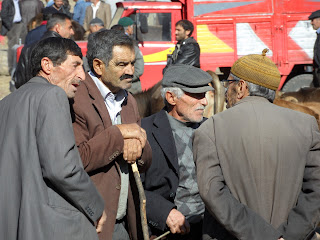
Farmers on a livestock market in Akşar
So far, I can't say I regret the decision. The area north of Erzurum used to be part of medieval Georgia. No wind-swept steppes here, but lush valleys, sometimes narrowing to a gorge, studded with the eerie remains of castles, churches and monasteries. Winter hasn't yet reached this remote corner of Turkey. Autumn reigns, painting the leaves of the trees lining the roaring streams in outrageous yellows, oranges and reds.

Thanks to my host Veysel I get to see every nook and cranny of the Georgian valleys. He is a vet, and I often join him when he is needed at one of the farms in the neighbouring villages. Circumstances in these communities are primitive at best, but that doesn't deter Veysel. It's a treat to watch someone do his job with such ease and confidence. Without batting an eyelid he stuffs a two-metre hose in the backside of a constipated cow, or stitches up a giant Kangal dog with a flesh wound the size of a baseball mitt—the result of a quarrel with a wild boar. Never a dull moment, in other words. If contemporary Georgia is only half as mesmerising as its medieval counterpart, I'm in for a good one.

Sunday, 6 November 2011

Visa Fever

Yakutiye Medrese
Uncomfortable chair. Bloody uncomfortable. I cross my legs and try not to fidget. This is not the time to draw unwanted attention. A minute passes. Then another. Utter silence. I look around. The watercooler looks inviting but is just out of reach. On the table next to it some used paper cups with a decoration of ice crystals and little stars. Stars of David. I smile at the irony but then catch sight of two framed ayatollahs hanging above the watercooler, eyeing me suspiciously. I avert my gaze and catch sight of my reflection in the mirrored wall in front of me. Not looking my best. Pallid face, tiny beads of sweat on nose and brow. I shiver. What was only a raised temperature back at the hotel is gradually evolving into an old-fashioned fever. I can feel its clammy hands around my throat.

Behind the semicircular opening in the mirrored wall the lower half of a face appears. I have to bend forward in order to see more than just a stubbly chin. ‘Good morning,’ I say. ‘No English,’ a taut voice replies. ‘Passport and reference number.’ I oblige. The face disappears, only to reappear a minute later. ‘Come back tomorrow,’ the voice says. A disembodied hand pushes some paperwork in my direction. Application form, I read. And something about a cash transfer. ‘But I’ve come to collect my visa, not apply for one,’ I mutter. ‘Come back tomorrow.’

Outside, it strikes me how pale the light is in Erzurum. And how cold the air. It’s the altitude. Here, at two thousand metres, winter starts in October. Each day, the mountains surrounding Erzurum become a bit whiter, as if a strange mould is slowly creeping down towards to the city.

Walking to the gate of the consulate, my eyes on the nasty surprise I’ve just been handed, I almost bump into a group of burly men smoking in silence. Passports, forms… We shake hands, sensing there is something that connects us. The men are from Turkmenistan and are on their way home from Germany, where they bought a couple of second-hand lorries. ‘Brauchen nur ein Transitvisum,’ one of them laughs, showing a row of gold teeth. Another speaks some English. ‘Come with us to the bank,’ he says, pointing at the transfer slip in my hand. ‘We have done this before.’

View of Erzurum
We squeeze ourselves into a decrepit yellow cab owned by one of them, and, as we drive into the city centre, sing the praises of Iranian bureaucracy. On Cumhuriyet Caddesi, the city’s main street, we pull over at T.C. Ziraat Bankası, the city’s main bank. Inside, we’re met by utter mayhem. Children running around, old geezers slumping in their chairs, men in ill-fitting suits shouting into mobile phones. The taxi driver contemplates the scene for an instant, checks the number he has just received from the dispenser at the entrance and slowly shakes his head. Then he marches to the counter and slams down our passports and money. Five minutes later we are back in the taxi, everything settled and paid for.

That night, having watched the news on Al Jazeera about the devastating earthquake in the Van region, only a few hundred kilometres away, I dream feverish dreams about taxi rides through a shattered city where people can only be pulled from under the rubble if they’ve got their paperwork sorted out. ‘Brauchen nur ein Transitvisum,’ a voice gasps over and over again. Then it starts snowing and everything becomes silent.

Two days and three visits later, I close the door of the Iranian consulate behind me, passport in hand, visa in passport made out to a certain Mr. VANAVLIET. Just a small typo, I tell myself, nothing that a stern ayatollah will lose any sleep over. I breathe in the fresh air, feeling better than ever, and head back to the hotel.

Friday, 28 October 2011

Lone Wolf

The Turks I meet along the way are willing to accept everything. That I’m cycling to the other side of the world. That I gave up my job in order to do that. Even that I’m still wearing cycling shorts now the temperature has dropped into the single digits. But why, they keep asking, why are you traveling alone? They just can’t seem to get their head around it. Joking that I don’t have any friends only makes it worse. ‘What is wrong with you?’ they all but say aloud.

But how to explain the joys of riding alone? It’s not something you can quantify or point at. Rather, it’s a state of mind, a mental equilibrium that is closely connected to the simplicity of cycling. Steady legwork not only carries you to distant climes, the same motion also seems to siphon off any unwanted thoughts, not unlike a pump draining a murky morass. When there is nothing but road, bike, horizon: that’s when the going gets good. Chitchatting with a travel companion or being forced to look at his sweaty back all day would simply drive a stick into this mechanism.

This isn’t to say that it doesn’t get a bit lonely at times. Eastern Anatolia isn’t exactly densely populated, and it often happens that a long day sees me pass through only a handful of hamlets. The other day, somewhere in between Kayseri and Malatya, all life seemed to have gone on strike. No villages, no vegetation, nothing. More than one hundred kilometres of sheer emptiness. Having just conquered the umpteenth barren hill, I suddenly heard an echoing cry. To my left I saw a middle-aged man waving frantically. It was clear he wanted me to follow him, so I got off my bike, crossed the road and scrambled up a mound. With a sweeping gesture he showed me a vast field, where a flock of sheep was peacefully nibbling away on what little grass there was left. Four imposing Kangal dogs were keeping a watchful eye. Proudly, the shepherd told me all about his work. I didn’t understand half of what he was saying, but then, nor did he and his friend when I told them about my trip. All of that seemed inconsequential, however. It was enough to just stand there for a while with these two men and watch the sun break through the clouds for the first time that day.

In Malatya I was welcomed by my host Ilyas, his wife Zehra and Diran, their four-month old boy. Staying at their place once again reminded me of the fact that without couchsurfing a journey like this would be virtually impossible. Solitude is great as long as I am pushing the pedals, but even lone wolves need some company every now and then. Couchsurfing was set up with exactly this in mind. It allows travelers to stay with locals and become part of their lives for a few days. A great way to unwind, plus you get to look beyond the main attractions and see a place for what it really is.

High on all the good company I took it a step further and signed up for a group trip to Nemrut Dağı, the monumental tomb of a long-forgotten king high up in the mountains south of Malatya. The ‘group’ turned out to be me plus two couples from France and Korea. Still, the five of us had great fun trying not to think of dying a horrible death as we raced to the summit in a ramshackle minibus. We got there just in time to see the sun set over the huge stone heads gazing out over the Tigris basin. After spending the night in a very basic hotel just below the summit we went back to see the sun come up from the eastern terrace. A truly communal spirit arose among the thirty or so spectators as the sky put on its multicoloured robe. It was a splendid spectacle, but somewhere I could hear a lone wolf howling at the moon.

Wednesday, 19 October 2011

Çay?

Still not boiling...
It’s become a bit of a pattern here in Turkey: people waving an outstretched arm at me whenever they catch sight of me, as if bouncing an invisible basketball. It’s not that they’re urging me to slow down, though I wouldn’t blame them if they did—on certain near-vertical descents I’m scratching at the surface of the sound barrier. No, the waving motion indicates that people want me to stop and come over. The first question is always the same. Çay?

I’ve come to regard these invitations to a cup—or, rather, a tiny tulip-shaped glass—of tea as perfect little breaks. Frankly, I get more invitations than I can accept. Often I’m forced to mime that I just had a cup two kilometres back. The other day, however, the waver’s timing was impeccable. Wrapped in rainproof gear, slogging uphill, I was simply dying for a sip and a bite. I’d felt it coming for quite a while. But that’s the thing with hills. You vow to take a break at the top, but when you finally get there the road beckons you to shoot down like an arrow and see what’s behind the next hill. It’s never the eldorado you somehow vaguely expect. Still, it’s hard to resist the call of the unknown.

Like me, the waving man had come prepared for foul weather. Dressed in a long yellow raincoat, he stood out for miles. He’d arranged a number of shallow wooden crates next to his ancient Massey-Ferguson tractor, each of them overflowing like a horn of plenty. Onions, tomatoes, melons, peppers... He immediately shoved a bunch of grapes in my face and then asked the immortal question. Çay? Why, yes please, I smiled, happy like a soaked cat that’s finally let into the house. He put me on a chair under a parasol, which could hardly cope with the downpour, and started fiddling with a samovar. Big handfuls of wet twigs disappeared into its belly. This clearly smothered the fire, but that didn’t keep him from stuffing the thing to the gills over and over again.

After a good thirty minutes the water in the top compartment came to a reluctant boil. He proudly showed it to me by opening a lid. By then, that cup of tea had become a matter of life and death. My numb fingers could hardly hold on to the fragile glass, and I’m afraid I failed to force my face into an expression of gratitude. In the meantime, not a single customer had shown up. In fact, barely twenty cars had passed. Having drained my glass I was naturally offered a refill. I groaned silently. All I wanted was to be on the road again and plunge into a long uphill sprint to get the blood flowing. But to decline a second glass is like saying the first one was worse than something the bladder of a dying donkey would produce. So I accepted politely and tried not to burn myself while gulping down the tea as fast as I could.

After the next hill again no eldorado where the sun always shines but another fruit seller bouncing an invisible basketball. I kept my eyes glued to the map in front of me, looking for a spell to turn myself invisible, and sped by.